Why Travellers Began Packing Lighter on Multi-Stop Journeys
Why travellers began packing lighter: learn how luggage choices depend on handling, transfers and length of stay, so you can match a bag to your route.
Why travellers began packing lighter is a question about who had to move the luggage, not simply which bag came into fashion. A trunk could suit a long stay with arranged transport, while a smaller case could be easier to manage on a route involving several transfers. Those are practical contrasts, not proof of one universal historical shift: luggage habits varied with place, period, income, transport services and the kind of trip.
Why did travellers use trunks?
A trunk offered a sturdy way to store and protect belongings. Its firm sides could keep garments and personal items together, and it could be left in a cabin, luggage compartment or room rather than carried constantly by its owner. For an extended stay in one place, that capacity might be useful.
Its practicality depended on the arrangements around the journey. A traveller with porters, a carriage or assistance at stations could move a large case without handling it at every stage. Someone travelling independently, or changing vehicles often, faced a different calculation. The trunk was not inherently unsuited to travel; its usefulness relied on space, handling and the length of the stay.
What made luggage harder to manage?
Every transfer creates a moment when a bag must be lifted, collected, carried or kept out of the way. A large case may be easy to store on a ship or in a room but awkward on stairs, crowded platforms or narrow local vehicles. A smaller bag may be easier to keep close, though it has less room for belongings.
That trade-off does not establish when travellers as a group began to prefer lighter luggage. It helps explain why a person might choose it for a particular route. Changes in services and travel practices differed across regions and periods; without a specific historical source, it is safer to describe the pressures involved than to claim a single timeline or cause.
How did different transport affect the choice?
A carriage, railway, ship, tram or aeroplane presents different constraints. Some journeys provide space for a large case or a way to send it separately. Others require the traveller to move between services, climb stairs or keep belongings nearby. Carrier rules also vary, so an item accepted on one leg may need a different arrangement on another.
Later air travel made baggage limits and handling arrangements particularly visible to passengers, but it should not be treated as the sole cause of lighter packing. For any route, check the current rules for each carrier and consider the least convenient transfer. A bag that works for a direct journey may be cumbersome when the trip includes a station change and a walk to accommodation.
What changed between one long stay and several stops?
A long stay in one room can make extra clothing and personal belongings worthwhile. A trip with frequent changes of accommodation places more emphasis on keeping essentials accessible and moving the bag without assistance. The distinction is about the itinerary, not a rule that short trips must involve little luggage.
Accommodation matters too. A room reached by stairs may be harder to reach with a heavy case than a hotel with luggage assistance. Access to laundry can reduce the need to pack spare outfits, while formal events or specialist activities may require items that cannot easily be replaced. These details help decide what is genuinely necessary.
How can you choose luggage for a route?
Start with the demanding parts of the itinerary rather than the most comfortable one. Check what you will carry yourself, where you will change transport, and what must be available on arrival. Then choose a bag and contents that meet those needs without adding items for unlikely scenarios.
- Self-handling: Check whether you will carry the bag between each service. If you will handle it alone, choose a case you can lift and keep close; if staff or a transfer service will move it, consider whether a larger case is worth arranging.
- Stairs and walking: Check for stairs, long station walks or uneven streets on the route. If these are part of the journey, favour a manageable bag; if the bag can be delivered directly to accessible accommodation, a larger option may be workable.
- Vehicle space: Check the luggage rules and available space for every carrier. If a case does not fit the stated allowance, select a compliant bag or arrange another permitted way to transport it; if it does fit, still consider whether you can handle it at transfers.
- Length of stay: Check whether you will unpack in one place or change rooms. If you will stay put, extra belongings may be practical; if you will move often, keep the contents focused on what you will use.
- Laundry access: Check whether washing clothes is realistically available during the trip. If it is, plan to rewear suitable items; if it is not, pack enough clothing for the stay and avoid relying on an unavailable facility.
- Required equipment: Check the weather, planned activities and any formal occasions. If they require specific items, make room for them; if not, leave out bulky extras that have no clear purpose.
What questions help explain lighter packing?
Does packing lighter always mean taking less?
No. It can mean choosing a bag that is easier to handle or leaving bulky containers behind while keeping the items the trip requires. The useful measure is whether the luggage suits the route and stay.
Why can transfers favour a smaller bag?
Transfers may require the traveller to lift, carry or keep luggage close. A compact case can make those tasks easier, while a large case may still suit a journey with storage and handling arranged.
Are trunks unsuitable for travel now?
No. A trunk may suit a move, an extended stay or a journey where it can be transported separately and stored securely. It is less convenient if the owner must carry it through repeated transfers.
What is not worth the effort when packing lighter?
It is not worth pursuing the smallest possible bag if doing so leaves out clothing for the weather or equipment for a planned activity. Elaborate organisers are also unhelpful if they add bulk and work without making the bag easier to use.
How does this work on a particular itinerary?
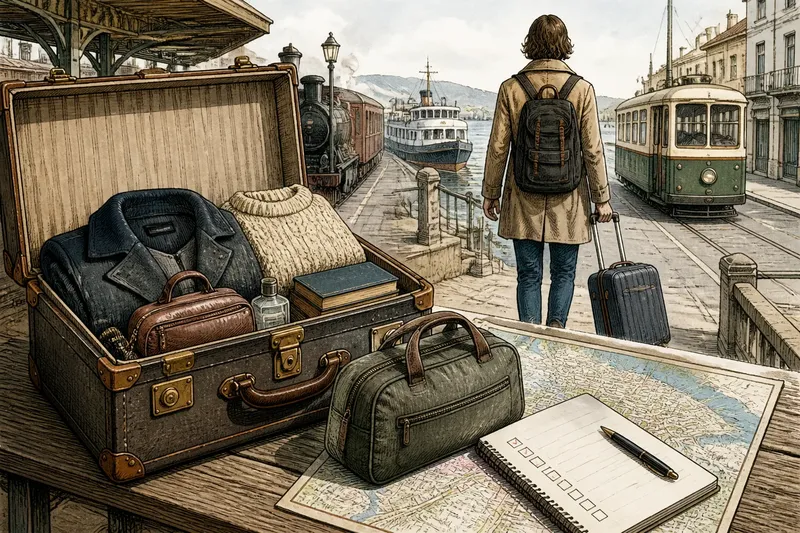
Say you are planning an invented trip from a railway station to a ferry, then by tram to a rented room. Your starting point is a large trunk, several outfits for a short stay, a coat, toiletries and a book; you will carry everything yourself, and the room has access to laundry. First, check the ferry and tram rules: if the trunk cannot be kept or stored conveniently, choose a smaller holdall; if separate luggage handling is available and suits the route, keeping the trunk remains an option. Next, remove outfits you do not need for the planned activities and keep the coat, toiletries and book. Finally, account for washing: because laundry is available, you can plan to rewear suitable clothes rather than pack a fresh outfit for every day. The resulting trade-off is clear: the holdall is easier to carry through the transfers, while the trunk would offer more storage but require workable handling arrangements.
This invented journey illustrates a decision, not historical evidence for when or why packing habits changed. Why travellers began packing lighter is best answered cautiously: the advantages of a smaller bag depend on the route, transport arrangements and what the traveller needs at the destination. Before choosing, check the most awkward transfer and make sure the bag can handle it without leaving an essential item behind.