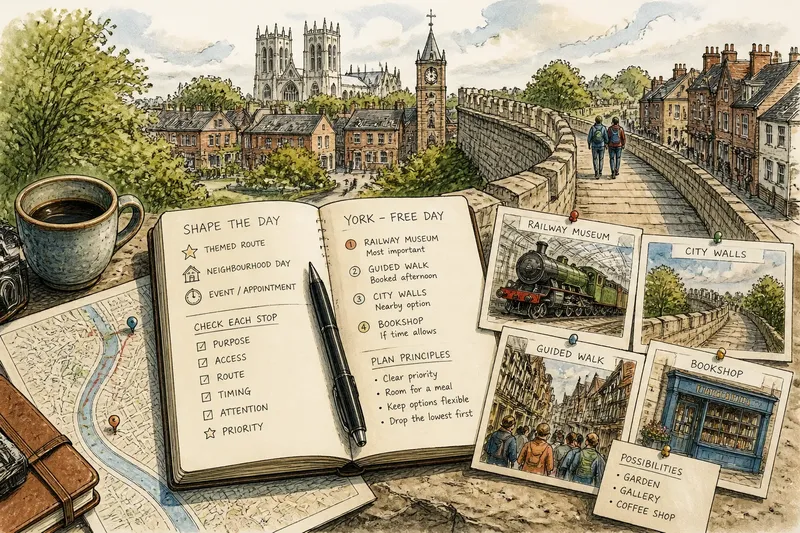
The One-Anchor Itinerary: Build a Day Around One Definite Plan
A one-anchor itinerary centres a travel day on one firm commitment, helping you manage its journey and timing while choosing what else suits your mood.

How do you plan a day around one important booking without turning every open hour into another appointment? A one-anchor itinerary gives the commitment a clear place in the day, then uses the rest of the plan to manage its practical demands: where to go, what to bring and what can wait.
What counts as a useful anchor?
An anchor is a commitment that shapes where you need to be or what you need to do: a timed museum entry, a ferry departure, a guided walk or a meal with someone you know. Choose it because it matters to the trip, not because an itinerary seems incomplete without a booking.
Keep the anchor specific. “Visit the old town” describes a broad interest, while “meet the guide outside the cathedral entrance” gives you a place and an action to organise around. Check the booking details, including the meeting point, admission requirements and the provider’s instructions.
How do you plan the logistics around it?
Write down the commitment’s location and what must happen before it begins. Depending on the plan, that may include getting a ticket ready, finding the correct entrance, collecting a rental item or following a dress requirement. Treat these as part of the commitment rather than separate errands to squeeze into the same stretch of the day.
Then check the route using a map and the relevant transport information. Look for the right station or stop, any changes between services and a straightforward way to reach the meeting point. If the journey is unfamiliar or the instructions are unclear, ask the transport provider or venue for clarification rather than relying on a guess.
Say you have a timed cooking class in a district you have not visited. You note the class address, save the booking details, check the route from your accommodation and identify the entrance described by the organiser. You then plan to arrive with time to locate it; the result is a clear departure plan, with no need to add another booking just to occupy the journey.
What should fit around the anchor?
Choose any additional plan by asking whether it supports the day or complicates the logistics. A nearby café, a market on the route or a walk through the surrounding streets may fit naturally. A second timed visit on the other side of town may bring another journey and another deadline.
Pay attention to what you will need for each activity. If the anchor involves walking, bring suitable shoes and a layer for the conditions. If you will be carrying shopping or luggage, decide whether it can stay at your accommodation or whether the venue permits it. These small choices can determine whether an optional stop is comfortable or simply inconvenient.
- If the extra stop is close to the anchor and has no fixed entry time, then keep it as an option; if it requires a separate cross-town trip, choose a nearer activity or skip it.
- If the venue requires a ticket or booking detail, then save the relevant confirmation where you can access it; if the instructions are missing, contact the provider before setting out.
- If the route depends on a particular transport service, then check the operator’s current information; if the route changes or is unclear, choose a simpler route or ask the operator.
- If you will carry bags or equipment, then check the venue’s rules and your storage options; if the items are not permitted or practical to carry, leave them securely elsewhere or remove the stop.
- If weather affects the planned approach, then check conditions and choose suitable clothing; if the route would be uncomfortable or unsafe, use an appropriate indoor alternative or return to your accommodation.
- If the added activity has its own start time, then consider whether the journey and transition fit comfortably; if they do not, keep only the anchor.
What if the timing or arrangements change?
Check the provider’s latest instructions before leaving, especially when admission, transport or local access arrangements affect your plan. If the anchor moves, is delayed or is cancelled, decide first whether the new timing still works for you. Avoid keeping optional plans that now depend on a rushed transfer.
Keep an alternative in the same area only if it is genuinely useful. For an outdoor visit, a covered arcade or a nearby café might suit a change in weather; if neither appeals, you can drop the idea. Preparing a full replacement schedule for every possibility is not worth the effort.
What do travellers ask about a one-anchor itinerary?
Can a meal reservation be the anchor?
Yes, if the meal is a priority or the booking fixes where you need to be. Check its location and any arrival instructions, then choose nearby activities only if they fit without adding an awkward journey.
Does every travel day need an anchor?
No. A transfer day or a visit with no timed commitments may not need one. Use an anchor when a particular booking or meeting needs to shape the day.
What if my companion wants more planned activities?
Agree on the shared commitment and its practical arrangements first. Then discuss which additional activities are genuinely important to each person, including whether you are happy to split up and meet again.
How do I decide whether an optional stop fits?
Check its location, opening or booking requirements, route and what you need to carry. Keep it if those details work alongside the anchor; otherwise choose a simpler nearby option or leave it out.
Which details deserve your attention?
For a one-anchor itinerary, prioritise the booking instructions, meeting point, route and anything you need to bring. A short note with those details is more useful than plotting every turn between optional stops. Knowing the practical requirements lets you make a calm decision about what to do next, without treating every available hour as a task to fill.